Value Analysis (VA) -
UNI EN 1325-1:1998, UNI EN
1325-2:2005, UNI EN 12973:2003 –
created by Lawrence D. Miles in
1943, is a method that provides
an operating technique utilizing
a crative and organized
approach. It is managed by a
group of people, each of them
selected by their expertise in
specific subjects and
coordinated by a VA expert.
On behalf of its customers, the
VA group uses a functional and
economic process in order to
establish the value of an entity
– which can be an idea, a
project, a product, a service,
an organization or any
combination of them – and to
evaluate solutions comparing
them by only one numeric
parameter defined as the “value
index”. This activity is
coordinated by the VA expert,
also called “decisor” with the
help of some experts in many
different subjects and one
non-expert, also called
“provoker”.
The VA method considers not only
the efficiency and effectiveness
at the time the analysis starts,
but also all the period of time
analyzed – hypothesized life
cycle (hlc) -. Therefore, VA
analyzes and verifies all the
components that assure the
performances’ endurance in the
course of time.
The strictness by which the
interdisciplinary activities are
performed – coordinated by the
VA Analyst – and the possibility
to measure the needs’
satisfaction are two main
aspects that differ VA from
other similar decision model
methods. The considered method
is examined in terms of utility
and global costs.
The team-work activity is
coordinated by a VA expert, a
professional figure which
performs interdisciplinary
activity phases aiming to give a
well-balanced result,
considering only the Index of
Value (Iv).
This allows to define a value
hierarchy among all the possible
solutions that will be pointed
out to the decision makers.
THE OPERATING METHOD IN FIVE
PHASES
After the informative phase, the
VA group’ activity consists in
the individualization and
definition of function/activity,
in order to gather them in
meaningful functional circles (AFS).
1.
information and
functional analysis
2.
creativeness
3.
evaluation and selection
of the proposals
4.
development of the
selected proposals
5.
presentation of the
selected proposals, set in order
by priority
Once evaluated the proposal
solution, the VA group produces
alternative solutions and
evaluate them by Value Index
during the creative phase.
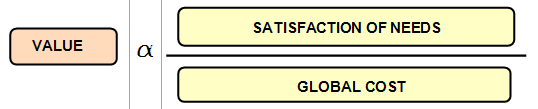
concept of value according to
Miles
The optimisation of value,
according to Miles, can be
achieved through the equilibrium
between the parameter - which
measures the satisfaction of the
related needs - and the
resources used for this purpose.
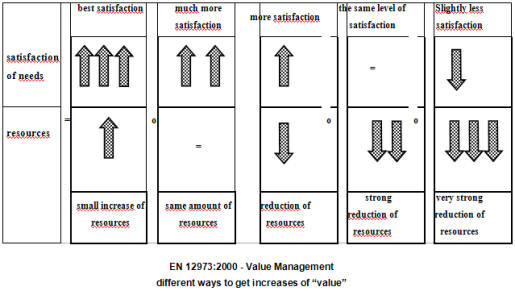
It is important to consider that
the Value can be improved not
only through the growth of
needs’ satisfaction, but also if
the used resources become
bigger, in case the need’s
satisfaction grows up more than
the employment of resources.
In the informative and function
analysis phase, the information
carried out from Preliminary
Documents is gathered, analysing the
preliminary project drawings and
pointing out the objectives, the
limits with the expected
performances, the need’s classes,
the functions, the requirements and
the global costs related to the
hypothesized life cycle.
In the informative phase,
after defining the objectives, the
limits, and the customer and user’s
needs, the VA group analyses the
subject as it has been presented and
it gathers information and data
regarding the global costs’
estimate. At the end of the
informative phase, the VA team
points out the significant
functional areas among which it
selects areas of major functional
incidence. This is possible by
identifying the primary functions
that can satisfy the expressed
exigencies, by eliminating the
secondary functions, by evaluating
the solution proposed by the
planning group and by suggesting the
alternatives proposed by the VA team
during the creative phase, giving a
value index to each function.
In the creative phase, the
functions are pointed out as they
are presented in project drawings,
defining them with an active verb
and a measurable noun. Alternative
solutions also emerge while
defining and classifying other
possible functions.
In the analytic, selective phase
the Value Index for the primary
solutions considered is determined.
In the phase of development
of the solutions to be proposed, the
team introduces all the elements
needed to demonstrate their
validity.
In the phase of the solutions’
presentation, the team makes a
report to the Project Manager about
the achieved results in order of
priority according to the determined
value.
In the phase of the results’
implementation, the team
analyses the reached results in
order to plan possible improving
modifications, taking into account
the economical resources which can
be exploited.
VALUE ANALYSIS
An Interdisciplinary Method to
Manage
the Complex Entities in the optics
of the
Sustainable Development
The relationship among the
functions’ utility and the global
costs (value index in the meaning of
Lawrence D. Miles) is crucial at the
moment when we need to measure the
characteristics in terms of
performances.
The reference to the global cost
allows to program the interventions
inside the available resources
undertaking any initiative, but also
in future perspective and of the
respect of the conditions of a
sustainable development, for the
actual one and for the future
generations.
In the case in object, how much now
affirmed must be brought to an
effective interdisciplinary
approach, to confer utility and to
assure not only the necessary
resources for the safeguard, but
also and above all for a positive
tourist project .
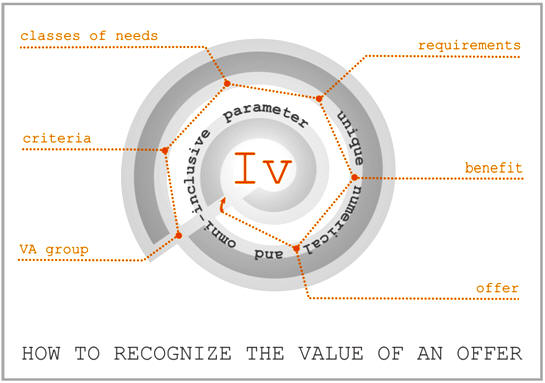
To individualize and to give
strategies inside a royal
sustainability of the initiatives,
passing from enunciations of
principle, to realistic projects of
feasible works and profits, VA
proposes to adopt a method founded
on the concept of "value" receipted
in the European Standards UNI EN
1325-1:1998 - Value Analysis - VA -
and UNI EN 12973:2003 - Value
Management. Therefore, it is
possible to put in the same table
all the necessary competences and,
through the activity of an unique
coordinator - VA expert - to bring
all the different aspects to a
global integrated project.
Value Analysis, that has been
introduced in Italy by the law on
the public jobs also, it founds on
the functional analysis and on the
comparison among more proposals -
through the Index of Value - the
worth of the functions to keep in
mind of all the elements that
compete to the sustainable
development. Connected to the nature
of the ground, to the regimazione of
the waters, to the hydro-geologic
equilibriums up to the landscape,
technical, technological,
partner-economic and cultural
aspects, the endowment of
infrastructures, of receptive
structures, etc. In the global costs
they are inclusive the managerial
aspects related to the interventions
and to the works in the whole cycle
of life, from the construction to
the transformation in order to have
a new destination of use up to the
demolition.
The speed of the actual changes and
the evolution of the social and
economic situations ask for the
developments of a culture based on
coordinated and interdisciplinary
contributions to support the
political decisions.
Value Analysis is addressed, by
nature and definition, to products,
services, goods, organizations as
well as to plans of any product or
service. For this reason it is
correctly acknowledged that every
plan can be improved in conformity
with expressed requirements,
performance and costs.
The applications can concern
programs and the planning of
services or products both of
organizations and corporations. In
the building field, the attention
may be focused on the urban ambit,
buildings and single components.
Another interesting application can
even concern the use of destinations
compatible with real estate of
historical and artistic value.
In order to
single out strategies to make the
initiatives sustainable, getting
from the enunciation of the
principles to realistic projects
which can be achieved and can be
useful to the community both at
present and in the future, it is
necessary to define the Responsible
for the Procedure, a professional
with complete knowledge of the
public works’ problems, capable to
put on the same table all the
necessary knowledge and to bring all
the aspects to unity in an
integrated program based on the Dpp,
the necessary condition to assure
the knowledge of the functional
needs of any “entity” in
relationship to the pre-established
requirements and to the expected
performances inside preset global
costs.
Centre for European Policy Studies (CEPS)
di Brussels
REPORT FROM
“Workshop
Regionalism and Globalisation in
Climate Policy”
Montecatini Terme, 25 Settembre 2003
United Nation University
“Regionalism and Globalisation in
Climate Policy”
Pier Luigi Maffei
delegated by
Magnifico Rettore dell’Università di
Pisa
Prof. Marco
Pasquali
VALUE ANALYSIS
an interdisciplinary method to
manage
the complex entities in the optics
of the
sustainable development
……….“At
Universities climate change related
issues are taught in several
disciplines. Research is done on
renewable energy, biofuels, and many
more issues. By combining chemistry,
engineering and other fields of
study innovative solutions can be
created. The “value analysis”
approach, which loocks at the
sustainability of whole ecosystems,
is such an approach. Now it is used
by the International Organisation
for Standardisation (ISO) resulting
in environment and sustainable
developmennt standards that take
into account the whole value
chain.”………….
BIBLIOGRAPHICAL REFERENCES
-
Miles D.L., Techniques of Value
Analysis and Engineering, Mc. Graw
Hill, New York 1972
-
Dell’Isola A., Value Engineering in
the construction industry 1982
-
Dandri G., Costruire con l’Analisi
del Valore, Edilstampa, Roma 1993
-
Kirk S.J., Spreckelmeyer K.F.,
Enhancing Value in design decision,
U.S.A. 1993
-
Maffei P.L. e altri, 1996, Qualità
totale e analisi del valore nel
processo edilizio, ETS, Pisa
-
Maffei P.L.,1999, L’Analisi del
Valore per la Qualità del Progetto
Edilizio, IlSole24Ore,Milano
-
Maffei P.L.,2001,Il concetto di
valore nell’architettura tecnica, Il
Sole24Ore, Milano
WEB SITES
·
www.aiav-valore.it
·
www.cesav.info
·
www.go.to/metodo
·
www.costruzioni.net
·
www.lavoripubblici.info
·
www.progettotrio.it
Prof. Ing. Pier Luigi Maffei
Dipartimento
di Ingegneria Civile - Università di
Pisa
Architettura e Urbanistica
56126 Pisa (Italy), Via Diotisalvi,
2
e-mail: plmaffei @ ing.unipi.it
-
Professor of Technical Architecture
at the Faculty of Engineering of the
University of Pisa
-
Member of the work group “typology
and category of Public works for
Standard Cost determination” at the
Authority for Public Works - Rome
-
President of AIAV - Italian
Association for Value Management and
Analysis.
-
Value Analysis expert in the
European Commission –
Directorate-General XII: Science
Research and Development –
EE19981A17705
-
Member of EGB - European Governing
Board for Value Management in Europe
-
Member of SAVE International – The
Value Society – USA - Member 30369
-
V. President of Italian Association
DAIEE - Design for All Exchange
Europe
-
Member of the scientific committee
of “Qualità”, - official magazine
of AICQ – Italian Quality
Association
-
Member of the scientific committee
of “Progettare per la sanità” -
official magazine of CNETO
-
Responsabile per la Regione Toscana
del CNETO Centro Nazionale Edilizia
e Tecnica Ospedaliera
-
UNI Team Leader in the workgroup
“Value Analysis”
-
UNI Member of the workgroups:
“Quality and Reliability” and
“Economical evaluation Techniques”
-
UNI Representative in the CEN –
Value Management European commission
-
Presidente dei Corsi di Studio in
Ingegneria Edile (Laurea e Laurea
Specialistica) - Università di Pisa
-
Presidente del Comitato Scientifico
del CeSAV, Centro Studi per
l’Analisi del Valore – Dipartimento
di Ingegneria Civile dell’Università
di Pisa
-
Membro del Consiglio Direttivo del
CeNSU - Centro Nazionale Studi
Urbanistici del Consiglio Nazionale
Ingegneri, Roma
-
Docente di Complementi di
Architettura Tecnica del Corso
applicativo Ufficiali Superiori e
Ufficiali del Ruolo Normale a nomina
diretta - Accademia Navale di
Livorno
-
Docente di Politiche urbane e
territoriali del Corso di Laurea in
Scienze per la Pace - CISP - Centro
Interdisciplinare Scienze per la
Pace – Università di Pisa
-
Fondatore e Presidente di METODO,
Associazione Socio-Culturale –
Direttore Editoriale della Rivista
-
Membro del Comitato Scientifico del
Centro Studi Polis-maker del
Politecnico di Milano-Polo Regionale
di Como e del Master “Il Polis Maker
per la gestione della trasformazione
urbana”
-
Membro del Collegio Docenti del
Dottorato di Ricerca in “Scienze e
Tecniche dell’Ingegneria Civile”
dell’Università di Pisa
-
Membro della Giunta del Centro
interdipartimentale agro-ambientale
Enrico Avanzi - Università di Pisa
-
Fondatore e Direttore Editoriale di
METODO - Rivista di architettura,
politica internazionale, storia,
scienze e società Pisa
-
Membro del Comitato Scientifico
della Rivista “Qualità” – AICQ
-
Coordinatore Gruppo di Lavoro 279
«Analisi del Valore” UNI - Ente
Nazionale Italiano di Unificazione
-
Rappresentante UNI nella Commissione
Europea CEN TC 279 - Value
management
-
Responsabile per la Regione Toscana
dell’UCIT – Unione Cattolica
Italiana Tecnici
-
Consulente dell’Autorità per la
vigilanza sui lavori pubblici per i
Costi Standardizzati
-
Consulente dell’Unità tecnica
Finanza di Progetto del CIPE
-
Membro del Comitato per la
Promozione del Partenariato Pubblico
Privato - PPP


